
Anatomy of a Forced Confession: How the FBI Broke an Autistic Man in the J6 Pipe Bomb Case
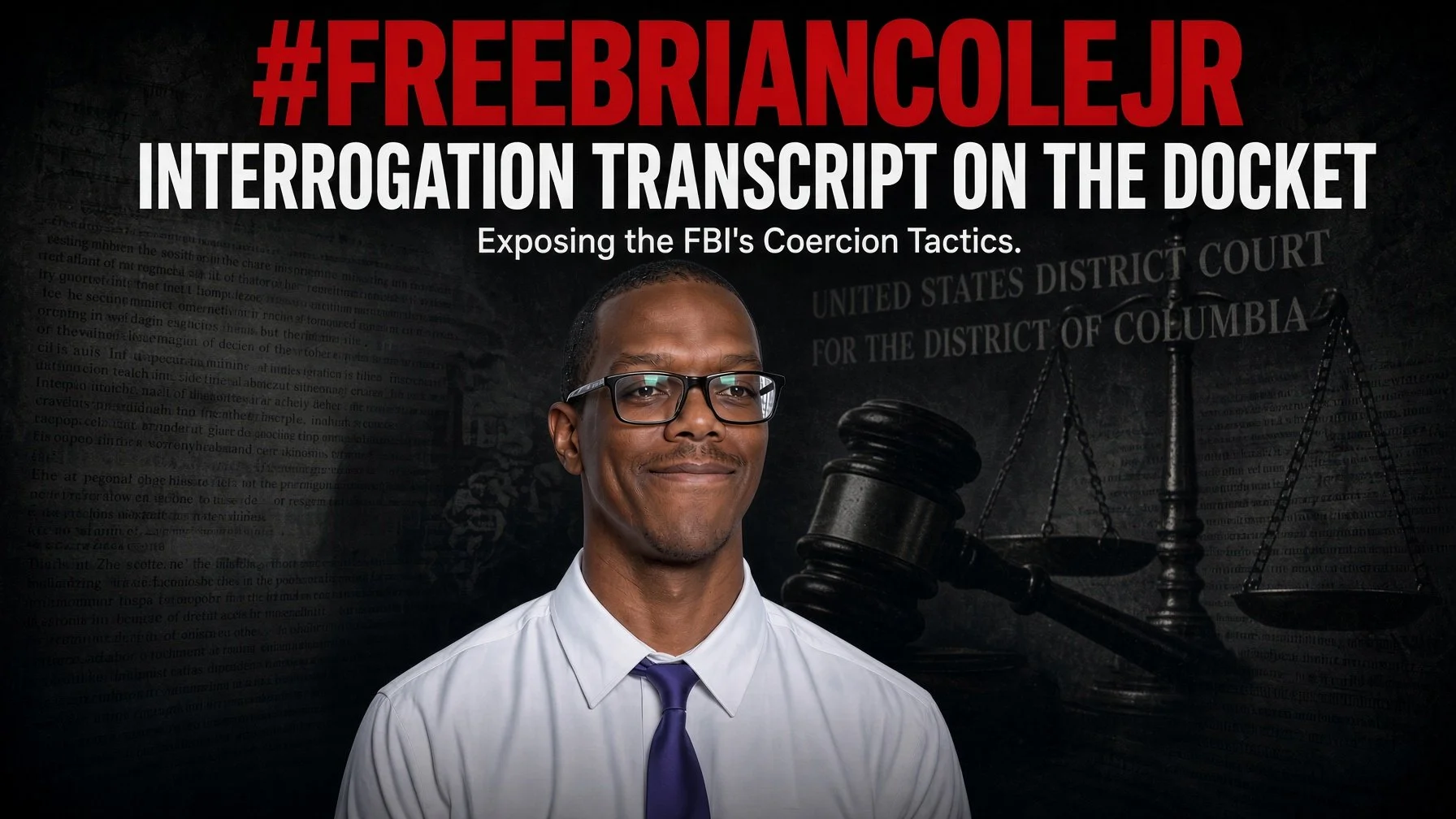
The government’s case against Brian Cole Jr., the man accused of planting the January 5, 2021 pipe bombs outside the DNC and RNC, is built entirely on a confession. But newly released court filings and interrogation transcripts reveal exactly how that “confession” was obtained.
Alleged J6 Pipe Bomber "Confession" Interrogation Transcript RELEASED!
https://x.com/robgouveiaesq/status/2105297949463060609
Alleged J6 Pipe Bomber "Confession" Interrogation Transcript RELEASED! https://t.co/CMaJhsLwpo
— Robert Gouveia Esq. (@RobGouveiaEsq) September 30, 2026
In a staggering 42-page Motion to Suppress (Document 102), defense attorneys lay out a chilling, hour-by-hour timeline of FBI agents deploying textbook psychological manipulation against a highly vulnerable suspect. The filing requests that the judge throw the "confession" out of court entirely, arguing it was illegally coerced from a young autistic man whose will was systematically dismantled.
The Dawn Arrest and the Setup
To review the interrogation, the defense retained Dr. Richard A. Leo, a prominent law and psychology professor who has consulted on 2,500 disputed-confession cases and testified as an expert over 400 times. After reviewing the recording and transcript, Dr. Leo concluded that the session was a guilt-presumptive, accusatory interrogation that deployed classic psychological techniques—isolation, confrontation, and minimization—specifically engineered to break a suspect.
Before December 4, 2025, Brian Cole Jr. had no criminal history of any kind. He is a high school graduate who works in his family’s bail-bonding business and has lived in the same Woodbridge, Virginia home with his parents for 21 years.
His first encounter with law enforcement began at 6:58 a.m. when he walked to a 7-Eleven to buy food. He was suddenly surrounded by FBI agents pointing guns at him. Hours later, he was sitting isolated in a Washington Field Office interview room with two special agents. He was not told why he was there until after he had waived his Miranda rights.
Exploiting AutIsm and Sensory Collapse
A licensed neuropsychologist has diagnosed Cole with Autism Spectrum Disorder, Level 1 (Requiring Support), and he also suffers from obsessive-compulsive disorder. Throughout the interrogation, Cole narrated his own unraveling to the agents in real-time.
He explained that he builds his life around strict routine and avoids "anything that deviates" from it.
He explicitly warned them he was "super introversive" and had "trouble even maintaining a conversation like this".
As the hours dragged on, his physical and mental state collapsed. He gagged mid-sentence, shivered so violently agents had to wrap him in a blanket, reported severe stomach pain, and told agents his mind had gone "blank".
During a break, the FBI's own recording caught him rhythmically chanting to himself—"I didn't, I didn't... Smallest, tiniest chances"—a self-soothing behavior known as "stimming," which is characteristic of an autistic person in acute distress.
Despite watching this physical and mental breakdown, the agents did not stop. They escalated.
Criminalizing Innocence and Threatening Family
For the majority of the interrogation, Cole repeatedly and desperately maintained his innocence. The transcript shows him repeating "please tell me this is a misunderstanding" and insisting "I didn't place the devices" over and over.
To break him, agents utilized three deeply unethical tactics:
Threatening His Family: Agents weaponized Cole’s deepest fear. Because Cole worked closely with his sister and grandmother in the family’s bail-bonding business, agents explicitly told him that if he continued to deny the accusations, every one of those family members—naming them directly—would have to come down to D.C. for aggressive FBI interrogations. They promised that if he cooperated, they "might not have to drag them all here".
Making Denial a Crime: When Cole refused to identify himself in a piece of surveillance video, agents threatened him with additional charges. They told him that "lying to federal agents is breaking the law. That's another crime". Seconds after being told his denial was a felony, Cole switched his answer to "Yes".
Minimization: To make a confession seem like the easiest way out, agents downplayed the crime. They repeatedly called it "one dumb mistake" where "no one got hurt," assuring him that if he just confessed, they could "put this behind us". They further promised that a day-one confession would be reported to their bosses as cooperation, assuring him that "hopefully that will help you down the line when you have to deal with the consequences of this action."
The Coerced Waiver and Contaminated Narrative
Once Cole finally broke, the agents celebrated by telling him "It's over". But it wasn't.
Federal law (the McNabb-Mallory rule) requires that a suspect be brought before a judge without unnecessary delay—typically within six hours. The agents bypassed this requirement entirely to keep interrogating him.
They placed a prompt presentment waiver in front of him, framing it as a way to avoid public humiliation in a courtroom. Visibly confused, Cole asked, "These are my rights, even if I signed it, right?". The agents answered "Yep," misleading him into believing he was retaining the very rights he was signing away.
In the hours of questioning that followed, the agents fed Cole the narrative. They supplied the locations, the route, the bench, and the timer settings. Cole, his will entirely overborne, simply confirmed the details in fragments and monosyllables.
The defense’s motion makes it explicitly clear: Brian Cole Jr. didn't volunteer a confession. It was systematically extracted by exploiting a disabled young man until he simply couldn't take it anymore.
Court Filings & Evidence:
Full Case Docket: https://www.courtlistener.com/docket/72099992/united-states-v-cole/?filed_after=&filed_before=&entry_gte=&entry_lte=&order_by=desc
Motion to Suppress (Doc 102): https://www.courtlistener.com/docket/72099992/102/united-states-v-cole/
Interrogation Transcript (Exhibit 102-1): https://www.courtlistener.com/docket/72099992/102/1/united-states-v-cole/
Support & Stay Updated
Our Related Article: https://stophate.com/mash/stand-with-brian-cole-jr
Official Legal Defense Fund: https://www.givesendgo.com/stand-with-brian-cole-jr-legal-defense-f
Family Updates on X: https://x.com/FreeBrianCole