From J6 to K Street: How Performance and Money Shape What Washington Hears
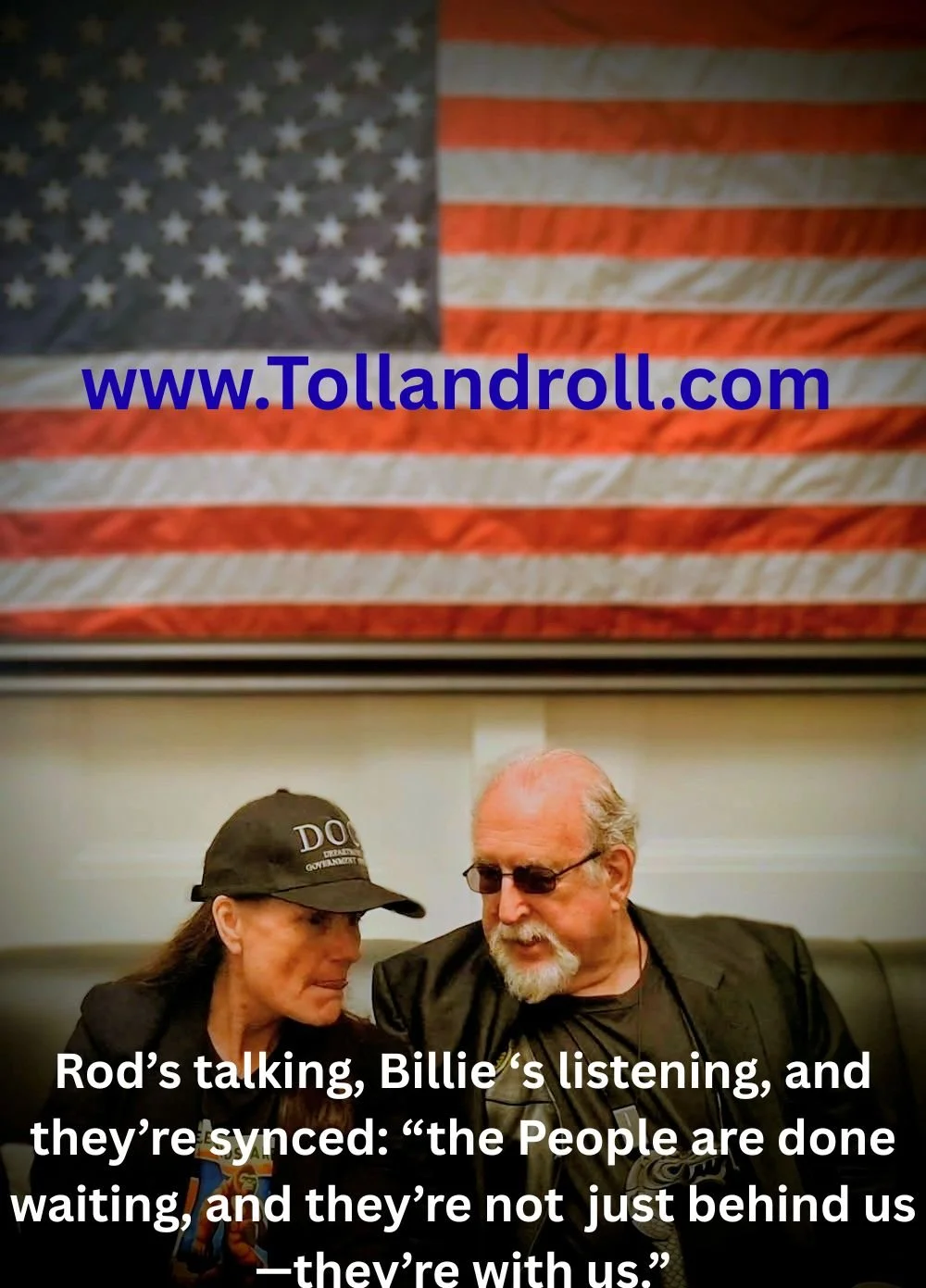
Toll and Roll™ is a bipartisan national delegation built to audit the web of deception, public records, court orders, and the systems that turn paperwork into power. We bring documented evidence, not slogans, and we push a legislative remedy designed to restore integrity, recover stolen assets, return trafficked children and adults, and shut down the pipelines that have devastated families across the country. This is my January 2026 field report from Washington, D.C., where we showed up the way the People require: binders in hand, facts on the table, and zero patience for being routed to “email the intern.” In this town, business is often done for donors and optics. We came to do business for the People, and to make it clear that the era of gatekeeping our liberties at the intake desk is over. OVER!
After our first formal meeting with the Department of Government Efficiency (DOGE) in early 2025, after our team put on the table what we calculate as massive recoverable fines, fees, and fraud exposure, we were later asked by multiple congressional teams for the same core package we had already provided to DOGE, including Judiciary-oversight staff and Congresswoman Kaptur’s team: the evidence set, the framework, and the “how this works”
backbone. That meeting was not a cold introduction: our delegate Matt Skarlatos had already hand delivered the requested evidence package to DOGE ahead of our near two hour meeting with DOGE May 2nd, 2025.
DOGE is now in receipt of a real federal initiative with an aggressive fraud and waste mandate, and its footprint has expanded across agencies, including scrutiny of regulator operations, yet our direct access narrowed as DOGE attorneys limited additional meetings, while continuing to receive submissions. We take that shift for what it often means in Washington: less talk, more process, an investigation posture. But we cannot lose the
legislative thread. Investigations can expose a crime; only sponsorship and passage of the People’s Remedy and Restoration Act can permanently shut down the pipeline that makes the same crimes repeat. One cannot negate the other.
We arrived in Washington on January 3, not for a photo op, not for a slogan, and not to blend into the well rehearsed rhythm of “constituent traffic.” We came because the People have been hemorrhaged, erased, and trafficked through systems that were built to protect them, and because the remedy is already written.
I and Irene Reichenbach were the first to get to DC on January 3rd. Irene is a fellow
advocate with a political and civic background that matters in a town that often measures
credibility by proximity. Reichenbach’s public biography reflects her prior involvement
with the Trump campaign beginning in 2015, including her work with the South Carolina
campaign effort and her account of singing the National Anthem at multiple rallies across
South Carolina and in the New England states, as well as attending the 2017 Presidential
Inauguration. She also appears by name on a 2015 published list of members of a South
Carolina Trump steering committee. She brings political experience to the table.
The first two days, January 3 and 4, were not glamorous. They were the kind of days
advocacy runs on: printing, sorting, cross checking, assembling binders, and aligning our
delivery plan for the Hill. We were preparing for what became the operational core of this
trip: January 5 drop-ins and follow-up rounds across House and Senate offices, bringing a
package of legislative materials that our delegation believes can no longer be treated as
optional reading.
What We Delivered: A Unified Remedy, Plus a Staff Directed “Fast Review” Breakdown
Our binders were built around The People’s Remedy and Restoration Act — The New
Declaration of Independence 2025, and the supporting materials that explain its structure
and intent. The Delegates spoke from DC – https://rumble.com/v747ct4-toll-and-rolling-in-dc-with-kirk-pendergrass.html?mref=99msr&mc=3p9ei
The binder packet (read the documents here- https://tollandroll.com/the-peoples-remedy-and-restoration-act-the-7-supporting-acts-for-clarity-title-iv-white-paper/ ) delivered in January 2026 included:
1. The People’s Remedy and Restoration Act (PRRA), the integrated framework.
The People’s Remedy and Restoration Act – The New Declaration of Independence
2025. Written by the Toll and Roll ™ Delegates, with decades of experience, and
first hand facts in whistleblower evidence.
2. A support letter for representatives to introduce and support the legislation.
(Included in the packet set provided.)
3. The preamble packet explains why the framework was separated into seven
supporting Acts for clearer intake and faster review.
4. Seven supporting Acts (created as a clarity package to allow independent
introduction while preserving the unified PRRA framework, consistent with staff
direction described in the preamble).
5. The letter to Senator Charles E. Grassley addressed how PRRA functions as an
enforcement remedy touching Title IV systems without narrowing the bill’s scope.
6. Title IV Policy White Paper mapping PRRA’s enforcement structure to foster care
and child welfare system vulnerabilities, emphasizing record integrity, audit
authority, and funding controls. Prevent the loss of children before they go missing,
not just what to do when they go missing. (AWOL)
The preamble to the supporting Acts states the separation was staff directed to improve
review speed and clarity, especially where junior intake layers are tasked with triage and
summarization, while also formally requesting escalation to senior policy and oversight
staff due to the asserted national security implications of compromised record
infrastructure. We complied with congressional direction to separate the integrated Act
into seven discrete bills because newer staff are often assigned to triage and summarize,
without the experience necessary to access the materials, it is a task, in my opinion, that
they should not be given to the junior staffers when seasoned whistleblowers and victims
are involved. I stated plainly to the senior staffer what any serious national security minded reviewer
knows: this subject matter is not routine constituent traffic, and routing it through under
empowered intake layers is a duty and risk failure, not a criticism of young staffers, but a
critique of a system that uses them as a gate, a deterrent.
January 5: Doors, Deliveries, and the Reality of Gatekeeping
On January 5, Irene and I began moving office to office, including stops tied to prior
interactions and relationships, and then circling back to offices where materials had
previously been delivered. We made deliveries that day to multiple offices including Rep.
Tim Burchett and Rep. Nancy Mace, among others, and we returned to prior contacts for
continuity. Irene worked as a staffer with Nancy Mace in the Trump administration’s first
campaign and she shared with her staff some stories of their time together on the front line
of the campaign.
At Senator Grassley’s office, the experience became a case study in how quickly “welcome”
can become “wall.” We were initially received politely by a junior staffer, a pretty young
blonde with doe blue eyes, who allowed us to sit while we requested to speak with Jennifer
Davis, identified to us as the scheduler. She was asked to facilitate a tram ride to the
Cannon Building and was all too happy to assist, until she wasn’t.
We explained we were Toll and Roll™ delegates following up on numerous emails for
scheduling, and we referenced our team’s work with Kathleen Arthur, a Title IV specialist
aligned with our submission, consistent with the Grassley support letter that names
Arthur’s supporting review and endorsement. Kathleen has been tasked by Grassley
himself, with organizing the Title IV bill work, and we referenced that role directly in
Senator Grassley’s office because Title IV is a hot button arena where our proposed
remedy is highly relevant. Yet her name and role did not open the expected door; the
reception shifted from courteous to abrupt and we were pushed back to “email process”
with no substantive meeting.
That leaves a hard question I cannot ignore: is this simply delay, or is the Title IV
assignment being used as a containment lane, an appeasement mechanism that keeps us
busy “inside the tent” while the full People’s Remedy and Restoration Act is quietly stalled
instead of advanced toward sponsorship?
The meeting with Jennifer Davis for calendar review and scheduling did not happen. After
the junior staffer conferred internally, the tone shifted: we were told scheduling must be
handled by email, and that Jennifer Davis, nor Tucker Aiken were available, despite the
fact that we had been communicating about scheduling for months and had previously
made in person contact, and met for near 2 hours with the Judicial Oversight staff
previously, expecting the promised follow up meeting with our whistleblower team. The
Judicial Oversight staffer recognized our Whistleblower designation. The abrupt change
was not merely disappointing; it underscored what many citizen delegations encounter in
Washington: when the issue is large, structural, and disruptive to entrenched interests, the
first response is often procedural deflection.
We proceeded to follow up with Judiciary staff connected to Tucker Aiken, where we
experienced a different standard of professionalism: staff were courteous, received our
message, and assisted us in moving to our next delivery point.
Upon reflection, and suggestion by our Delegate Irene, we reviewed Senator Grassley’s
publicly available campaign finance profile and donor base. The scale of institutional
influence was sobering: major giving flows from the insurance and health sectors, with
corporate contributors such as Blue Cross Blue Shield, Amgen, and Wells Fargo appearing
among the better-known names, alongside heavy support routed through PACs and
leadership PACs tied to sectors like securities and investment and health professionals.
Reading that list, you start to understand the resistance. Gatekeeping is not always
personal, it is often structural. The legislation we brought is designed to expose and cut off
the pipelines that let powerful systems profit from opaque records, captured processes, and
unaccountable intermediaries.
From Courtesy to Continuity: Rep. Clay Higgins’ Office and a New Primary Contact
We reached Rep. Clay Higgins’ office, where we reconnected with the continuity problem
that plagues congressional intake: people change, materials get lost, and institutional
memory resets. Our prior contact had moved on—the very staffer Congressman Higgins
had directed to meet with us, gather our whistleblower evidence and documentation,
receive the proposed bill, and help us navigate sponsorship with guidance from the office.
Congressman Higgins had promised us assistance and direction personally, through his
staff, during an in-person meeting where Oklahoma Representative J.J. Humphrey was
present and in attendance. It was a memorable meeting for another reason as well:
Congressman Higgins and Rep. Humphrey shared an unexpected common interest,
Sasquatch, Bigfoot, and Humphrey remarked, with a grin, that it was interesting to
discover Higgins was even more of a Bigfoot enthusiast potentially than him!
On January 5th we were back in Higgins office and introduced to Jordan Sorenson, who
received us warmly. She recalled overhearing, at the time of our prior meeting, the
Congressman promise to assist, and that this facilitation role had been assigned now to her,
yet she candidly acknowledged she had not seen the materials she was now expected to
inherit and move forward with. We surprised her by providing an updated binder and
reestablished the line of communication, communication of several emails in which she had
been CC’d on previously. She acted genuinely happy to meet us in person and thankful for
the binder. She then asked us to email her so we could meet with her that week while we
were in town. We did. We also called. The meeting did not occur. We now follow up.
For any delegation doing serious policy work, this moment matters: it confirms that
delivery is not adoption, and it explains why persistence is not a personality trait in this
town, it is a requirement.
January 6: On the Ground at the January 6 Commemoration
On Monday evening January 5, Tom Kibler, our delegate from Minnesota, joined us in
Washington. On Wednesday we covered the January 6 commemoration events with a focus
on what I consider the human cost and the political machine surrounding it, both the
genuine grief and the opportunism. We had not anticipated the distance and pace of the
walking, and Tom, fighting bad knees but refusing to quit, ended up bringing up the rear of
the parade. At one point, we had an actual police car protection escort behind us with lights
flashing, which made for quite a picture. I snapped it smiling: Tom, stubborn perseverance,
and a surreal Washington backdrop that said everything about endurance and the cost of
simply showing up.
We encountered individuals who described themselves as victims of prosecution tied to
January 6, and we also observed what I call the “post-event economy”: people branding
themselves as personalities, touring their own notoriety, and treating national trauma like a
stage. That contrast is real, and it is ugly. Meanwhile, the people who are not chasing the
spotlight are often the ones carrying the deepest damage and quietly trying to rebuild. In
my view, some of the more visible figures are being actively cultivated, packaged, and
monetized, scouted by managers, promoted as products, and pulled into a performance
culture that feeds on a tragedy that is still raw for others. It also creates a damaging
illusion for average Americans watching from home. When the loudest voices are the most
theatrical, the public is nudged into believing the entire story is manipulative or stupid, and
the media’s biased coverage amplifies that distortion. That is not right. The integrity of real
victims and real damages should not be judged by the behavior of a few who turn pain into
performance.
And I will say this as a reporter and an American who has watched federal narratives get
engineered in real time: I cannot ignore the possibility that some of this “performance
layer” is useful to power, that it functions as a modern form of narrative control, whether
by opportunists or by design. Is it possible this is another psyop, where a few are amplified,
managed, and pushed into chaos so the many can be discredited? I do not claim that as a
proven fact, I state it as a serious question born from pattern recognition: when confusion
and caricature dominate the headlines, integrity and truth become collateral damage.
We also listened to and met Michelle Witthoeft, “Micki”, Ashli Babbitt’s mother. Her grief
is not performative; it is enduring. Public reporting in 2025 described the U.S. Air Force
extending military funeral honors for Ashli Babbitt after an earlier denial. The family’s
pain does not resolve because the news cycle moves on.
That night, we had dinner with David and Cindy Sumrall. David has invested immense
time helping January 6 families and defendants navigate the machinery that grinds people
down, slowly, financially, and psychologically. He has been interviewed by nearly all major
news outlets and continues to be a formidable advocate for justice and reform. The meeting
was productive and, for us, it opened a new lane: aligning practical support for harmed
individuals and families with the broader Toll and Roll™ mission of system accountability
and records integrity.
I was introduced to David through Tea Hogan, our delegate and the mother of
internationally trafficked and kidnapped Jonah Rief. “Where is Jonah Rief”. Irene helped
us further to facilitate the connection with David by phone and in person in DC, she and
David and his wife already knew each other. Irene brought us together specifically to
discuss how the Toll and Roll™ mission can be seen by more Americans and not buried
under media bias, and David proved instrumental in helping shape the exposure and reach
of this reporting.
We are collaborating on a specific action aimed at helping January 6 victims, work that is
already underway. For now, we are keeping the details close until the timing is right and
the people it is designed to serve are protected.
January 7: Minnesota Fraud Hearing and the Problem of Political Theater
On January 7, Tom Kibler and I watched congressional proceedings tied to Minnesota
fraud concerns, an issue that resonates deeply with our delegation because we have
whistleblowers and documentation describing patterns of fraud pipelines across states and
programsIn fact, Tom Kibler has provided substantial documentation to Minnesota
representatives, as have other whistleblowers aligned with the Toll and Roll™ mission.
What I find striking is this: we have delivered thousands of pages of evidence detailing
alleged criminal patterns, software system malfeasance, and since May, audits and public
findings have begun to mirror what our submissions already documented, yet there has
been virtually no acknowledgment of the delegation, the broader mission, or the scale of
harm described by millions of victims, advocates, and the hundreds of whistleblowers who
have come forward with facts and records. Then, almost overnight, a young man with a
camera does “boots on the ground” videos and, suddenly, attention follows, headlines move,
and the same core issues start “coming out” as if they were newly discovered. I’m glad it is
coming out, but it should not be a way of shutting down whistleblowers and verified facts in
evidence of National Security.
I am glad it is coming out. But it must not become a convenient way to sideline
whistleblowers, bury verified documentation, or reduce matters with national security
implications to a personality-driven media moment. The Toll and Roll™ Delegation has
been delivering evidence for years, records, exhibits, and documented patterns that point to
systemic vulnerabilities, not isolated scandals. In fact, Faith Brashear, a member of our
whistleblower team, has submitted documentation on behalf of the delegation that is both
undeniable in substance and structurally aligned with the remedy we are proposing,
evidence built to support legislation, not just headlines.
A House Oversight hearing titled “Oversight of Fraud and Misuse of Federal Funds in
Minnesota: Part I” was publicly announced for January 7, 2026, focused on fraud and
misuse of federal funds in Minnesota’s social services programs. Tom Kibler is our
Minnesota Delegate, having delivered massive evidence himself regarding Racketeering
and Civil Rights violations and takings that strip the People of their liberties and wealth.
He and I were disgusted with the gaslighting and misdirection of hearing questions.
I watched the hearings with the eyes of a reporter and the frustration of a citizen: too much
posturing, too much narrative engineering, and not enough disciplined pursuit of
underlying system design failures. From my perspective, hearings are worthless if they do
not lead to structural remedies, auditable systems, enforceable controls, accountability
mechanisms, and the ability to seize and recover stolen assets when criminal enterprise has
been embedded into public infrastructure. That is the gap PRRA asserts it fills.
A Working Table, Not a Complaint Circle: The Bullfeathers Meet-and-Greet
That evening we held a meet-and-greet at Bullfeathers, a longstanding Capitol Hill
establishment. We were joined by advocates and victims of political and judicial
corruption, including Jessica Saxton and Tanawah Downing, Linda Shao, Brenda Daley,
and Kathleen Arthur. The value of these gatherings is not social. It is operational:
advocates comparing notes, identifying overlaps, and building a working coalition that
trades in solutions rather than recycling pain.
It was also one of those Washington moments that reminds you how quickly “chance” turns
into contact. A political consultant and lobbying specialist sat in our reserved area,
someone I did not recognize in the moment, though in hindsight I should have. He handed
me his card, which I stuck directly inside my purse without review. I gave him my straight
thoughts, “You’re stuck with us now. God sat you in our seat, and I’m going to walk you
through our mission.” When I followed up, he told me he wanted to help. Our
communications are ongoing, and once I looked at his card I realized who he was. I laughed
at myself in embarrassment for not placing him sooner. In D.C., relationships don’t always
begin in conference rooms. Sometimes they begin because a chair was taken, a conversation
was unavoidable, and the truth was sitting right there. God has a sense of humor and thank
goodness this man does too!
Texas Meetings, a Strategic Pivot, and a Call That Changed Our Week
Later in the trip, Christian McNally joined Tom and me for a series of meetings. McNally is
a victim of probate and financial crimes and says he holds substantial evidence of
racketeering connected to his case. He believes his mother was murdered, stabbed to death,
an assertion he says he can support with evidence, and he describes being stripped of his
finances, his family, and his right to a fair hearing. He also states that his elected
representatives and law enforcement have not helped despite his repeated attempts to
obtain assistance.
On Thursday the 7th the three of us, Tom, Christian and I attempted service of subpoenas
for a third party, successful in one and it was the U.S. Attorneys for DC, they also received
service of our binder. Together on Friday the 8th we held two strong appointments with
Rep. John Carter’s office and Rep. Michael McCaul’s office, facilitated with the help of a
constituent, Darla Goulla.
I also stopped into Congressman Sessions’ office to renew support around trafficked
children, because he was heavily involved in the Jonah Rieff case in 2013. In our
delegation’s history, that effort mattered: we were told the matter drew attention from
serious federal lanes, including Homeland Security and the Department of Defense. After
that period, Tea Hogan, Jonah’s mother and one of our delegates, reports she was
kidnapped, and she believes that event conveniently coincided with the investigation going
quiet. The Sessions staff was genuinely kind. Once I mentioned his prior involvement in the
Jonah case, the tone shifted to immediate interest, they asked specific questions, engaged
the facts, and we left with a clear intention to follow up and pick up where that work left
off in 2013.
Those meetings produced a pivotal directive: restructure the presentation for how
Washington actually reads. Not how it should read. Not how seasoned professionals would
read, but how intake layers read.
The result was the accelerated creation of seven supporting bills and a clarifying preamble,
a senior-staff-directed separation designed to make the framework easier to intake and
faster to brief, without sacrificing the unified intent. In plain terms, I was tasked with
turning a comprehensive remedy into “Legislation 101”, (privately known on our team as
“Legislation for Dummies”) a format built for quick triage and fast comprehension, but
directed to less educated young junior staffers.
That night, back at the house, I felt the weight of the assignment. The responsibility of
translating a comprehensive remedy into a format that survives Washington’s gatekeeping
culture is not clerical work, it is mission critical work. I knew it was possible to do, but I
also knew the action that would come following that massive undertaking was a legal one. I
should not be the one tasked with writing the next step after the separation of the bill. And,
with Rod Class not able to come I literally was in tears over the enormous tasks to follow.
And then the phone rang.
It was Kirk Pendergrass, the partner of the late Chris Hallet (RIP) of E-clause LLC. Pendergrass
learned, through our delegate network and Rod Class, our North Carolina delegate who
holds the only Congressional seal designation as a Private Attorney General and bounty
hunter for the Republic, that the work Chris began had not died with him. Kirk didn’t
hesitate he was on a flight the next morning and came to Washington, listened carefully,
and immediately grasped the full A-to-Z problem we were facing: not just the substance of
the remedy, but the procedural bottlenecks, the intake failures, and the strategy required to
move a citizens’ legislative package through a system built to stall it.
Then Kirk did something rare in this town. He didn’t offer vague encouragement or “let’s
circle back” language. He stepped into the lane Chris would have occupied, helping us
structure next actions, clarify sequencing, and translate binders into forward motion.
Chris Hallet’s work also matters here because, long before “DOGE” became a headline, he
and Kirk were building what we described as the first real risk-management team for the
Republic, designed to expose systemic fraud, stop the overreach and shut down the
American Bar Association, recover losses, and enforce accountability at scale. According to
our delegation’s communications and internal work history, Hallet’s model was briefed to
federal stakeholders, inside congressional hearings, including discussions that touched
members of Congress such as Senator Ted Cruz. And through that same delegate network,
Rod Class, our North Carolina delegate, who holds what he describes as a
Congressional-seal designation as a Private Attorney General and bounty hunter, was one
of the catalysts who urged Kirk to come to Washington and step into Chris’s lane. Chris
was gone before he could complete his work; we are not.
The Second Week: Printing, Splitting Up, and Real Progress With Real People
With Pendergrass on the ground, and with John Bloom, my partner and Toll and Roll™
co-founder, arriving with his wife Sarah, we regrouped, brainstormed, and executed. We
went back to print. Thousands of pages later, we had updated packages and returned to the
Hill.
We split teams across multiple House office buildings, and the meetings were productive.In
one notable moment, Tom and I were escorted by a member of Congress from New Jersey
to deliver a binder directly to a senior legislative staffer, prompted by a constituent case
involving Deb Golden, deed fraud, and FEMA related complications that underscored how
record manipulation can block relief even when federal assistance is on the table. As the
Congressman listened to me describe our Delegations mission he got serious and
determined to have his staff follow through. That is what progress looks like in
Washington: a moment where a human being with authority listens long enough for the
paperwork to become personal, and therefore actionable.
What We Learned, What We Saw, and Why We Are Not Done.
We left Washington once again, exhausted, hopeful in some moments, disheartened in
others, because Washington is still saturated with pay-to-play culture, lobby influence, and
procedural insulation that keeps ordinary Americans outside the room where decisions are
made. I overheard conversations that reflected how transactional the system can be. I
watched image, status, and access operate as currency. I overheard a lobbyist discussing a
practice I recognize as a form of financial manipulation: reshuffling or reclassifying “book
entries” so a preferred project or outcome can be paid for under a label it would not
ordinarily qualify for. In plain terms, it was the language of cooked books, funding routed
by designation games rather than transparency, merit, or the public interest.
Meanwhile, our delegation is traveling on credit, carrying the weight of families harmed by
deed theft, CPS and APS abuses, guardianship and probate exploitation, and what we
contend are interconnected fraud pipelines running through public-private record
platforms. The PRRA text frames these issues as systemic and national in scope,
emphasizing audits of land and court records and connected software, database systems,
shutting the software and AI backdoors and the creation of the Office of P.R.O.T.E.C.T.,
and enforcement mechanisms tied to recovery and restitution.
We need financial backing, and in my experience the money tends to chase the showboats
and the theater builders. Our work is not built for glory; it is built for liberty, for remedy,
accountability, responsibility and the restoration of the Republic. That means we need a
serious backer who is not compromised, someone willing to fund substance over spectacle.
Too much of Washington runs through bought and paid for pipelines, lobby influence,
donor leverage, and unelected bureaucratic gatekeeping, and we are trying to do the one
thing that threatens all of it: put enforceable power back where it belongs, with the People.
For readers who think “this is too big,” I will say this plainly: that is exactly why it
continues. People cannot fight what they cannot name, audit, or trace. Our position is that
the People now have a legislative instrument that names it, maps it, and demands action.
We’ve done the heavy lifting, we have brought the evidence by hundreds of whistleblowers,
thousands of advocates and millions of victims forward, this is for you!
We did not come to D.C. asking to be liked. We came to be heard, to be taken seriously, and
to insist, politely, professionally, and relentlessly, that these united States of America cannot
survive a future where public record infrastructure is treated like a private sandbox. We
went to DC to do the business of the People, not to protest but to work on your behalf.
Please support us, join us and become part of the remedy.
We are not done. We are building. And the next doors are already opening. We bring the
New Declaration of Independence 2025. Stand with us. Thank you for taking your time to
read this and get involved.
Support Toll and Roll ™ : https://givebutter.com/6M6d2Z
Follow the Delegates on FaceBook: https://www.facebook.com/groups/1208279204012735
Website: www.tollandroll.com for all the documents and information.